
Mobile proxies route requests through real carrier IP addresses rather than data centers or home routers. This fact determines the position of mobile proxies in the market. Datacenter IP addresses face bulk fingerprinting and blacklisting, while residential IP addresses are increasingly vulnerable as detection companies map ISP ASN ranges. Mobile IP addresses still pass many anti-fraud checks because mobile carriers assign addresses in a unique way. This is why mobile proxies are more expensive than the other two types of proxies.
A review of the best mobile proxy services in 2026 compares them based on factors that matter, such as price per GB or per month, pool size, supported protocols, and how rotation behaves in practice rather than on paper.
Why Mobile IPs Behave Differently from Residential or Datacenter Proxies
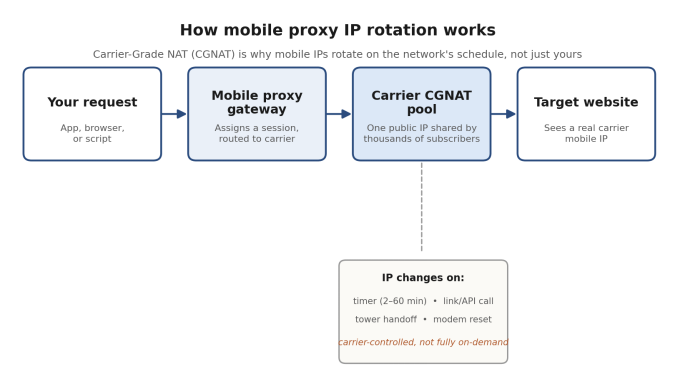
The reason mobile proxies do not get banned as easily is Carrier-Grade NAT (CGNAT). IPv4 addresses became scarce a long time ago. Mobile operators have never had enough public IP addresses for all subscribers, which is why CGNAT allows multiple mobile phones to share a single IP address.
This means that blocking one malicious party through CGNAT can also result in blocking all subscribers sharing the same address at that moment. Most anti-fraud systems are aware of this and therefore treat carrier IP ranges differently from server or fixed IP addresses.
However, there is a downside: rotation does not work the same way as it does with a datacenter proxy. When you request a new IP address from a datacenter proxy, you can usually get it instantly. With a mobile proxy, the IP change takes place only after the network connection is refreshed. This can happen because of a tower handover, a modem reboot, or a timeout.
IPRoyal warns users that “if IPs change more frequently than it is specified in the contract, it is caused by ISP’s own rotation which is beyond our control.”
Top mobile proxy providers in 2026, compared
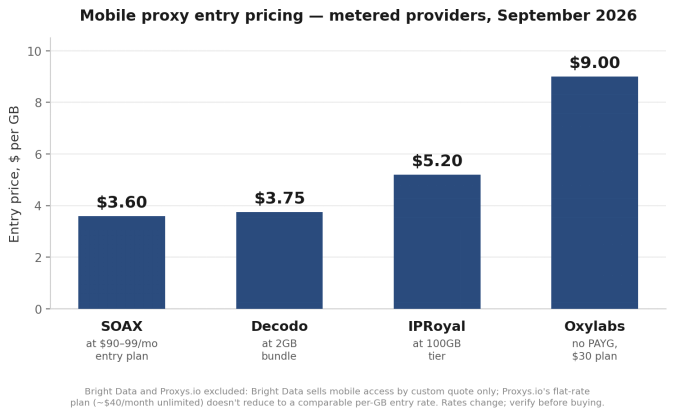
Six names cover most of the mobile proxy market by reputation and published volume: Proxys.io, Bright Data, Oxylabs, Decodo (the April 2025 rebrand of Smartproxy), IPRoyal, and SOAX. The table below lists entry pricing for six mobile proxy providers as published in September 2026; per-GB rates drop substantially at volume for every metered provider here, and proxy pricing pages change often enough that it’s worth confirming current numbers before buying.
| Provider | Entry price (mobile) | Billing model | Mobile proxy coverage | Protocols |
| Proxys.io | ~$40/mo flat, or pay-per-GB | Flat-rate (Personal tier) or metered | 15 countries; ~2,000–5,000 IPs per geo+carrier | HTTP, SOCKS5 |
| Bright Data | Custom quote only | Metered, KYC required | 195 countries claimed | HTTP, HTTPS, SOCKS5 |
| Oxylabs | $9.00/GB | Metered, plans from $30 | 195 countries; city/ASN/coordinate targeting | HTTP, HTTPS, SOCKS5 |
| Decodo (Smartproxy) | $3.75/GB | Metered, bundles from $7.50 | 195+ locations (combined network) | HTTP, HTTPS, SOCKS5 |
| IPRoyal | $5.20/GB (100GB tier) | Metered, or dedicated device from $130/mo | 4.5M+ mobile IPs; ~6-min rotation | HTTP, HTTPS, SOCKS5 |
| SOAX | $3.60/GB | Metered, plans from $90/mo | ~8.5M IPs; city/ISP/carrier targeting | HTTP, HTTPS, SOCKS5 |
Fig. 2 – Entry per-GB rates among the metered providers. Bright Data and Proxys.io aren’t shown; see notes below the chart.
Proxys.io
 Proxys.io provides four different types of its 4G mobile proxy services which are – Individual, Shared, and Premium along with one other pay-per-gigabyte option for users with unpredictable usage. The Personal option is different from the rest due to its flat fee for unlimited use. Users will have the option of having a private channel with guaranteed periods of IP rotation. However, because it will cost about $40 a month, this flat fee option is limited geographically as the countries users will have access to only include 15 markets as opposed to 195 markets provided by the competitors mentioned above. However, it is important to note that users of all tiers will be able to use either HTTP or SOCKS5 right away with no stage of set up involved.
Bright Data
Bright Data is arguably one of the most well-known names in the proxy industry, yet its mobile product seems to have disappeared from the self-service pricing site. It still is mentioned as one of the four types of IP networks in its guides, but obtaining it necessitates undergoing the same Know Your Customer process as residential proxies. This step requires verification, which has varying waiting times depending on the type of account, as evidenced by several 2026 reviews. Nonetheless, the mobile prices have not been published so far. The company advertises residential proxies as being $8 per GB pay-as-you-go (which is $4 as per the current promotion) or $499-$1,999 monthly for committed plans. In the meantime, it seems that mobile proxies are subject to the same sales process as the other types of proxy instead of being available for self-checkout. This is a fair compromise for a big compliance-dependent buyer, but a long wait for a small team needing to use the card and start.
Oxylabs
 At Oxylabs, the cost of mobile proxies starts at $9.00 per GB, and there is currently no pay-as-you-go model available since it was eliminated in March 2026. Thus, the available entry-tier package starts from $30. When it comes to volume levels, the price decreases to approximately $3.50-$3.90 for the highest tiers; the prices are reduced even further in case an enterprise package is negotiated. The targeting capabilities of Oxylabs allow it to reach even country, state, city, ASN, and coordinate levels, and as far as compliance goes, Oxylabs has both SOC 2 Type II and ISO 27001 certifications. One of the key considerations here is that Oxylabs has positioned itself in the market for teams which are willing to accept premium pricing and are not looking for an opportunity to test their idea at a $10 price point.
Decodo (Smartproxy)
Following its rebranding in April 2025, Decodo (the new name of Smartproxy), continues to offer its products and services without any changes in terms of pricing with mobile proxies starting at about $3.75/GB, and going down to $2.75/GB for larger amounts of mobile proxy bandwidth. The entrance cost of the service into the market makes it the cheapest among the competitors available in this analysis but it should be noted that the network of Decodo combines both residential, datacenter, ISP, and mobile IPs totaling over 125 million rather than just mobile IPs. The small minimum purchase is ideal for the team, which is only planning on trying mobile proxy solutions first before using their budget for it.
IPRoyal
The IPRoyal system comprises over 4.5 million mobile internet connections on the network types of third-generation, fourth-generation, and fifth-generation, and its operation is designed with auto-rotation in the range of six minutes with no limitations on the amount of data transmitted or duration of use. The pricing policy is about $5.20 per 1GB of utilization volume within the plan of 100GB of bandwidth and around $130 for the package operated with only one device for 30 days. Users of IPRoyal can be assured that their bandwidth is not affected by time constraints, which is especially helpful for those with sporadic usage of communication resources. Importantly for potential users of IPRoyal system, the operator underlines one of the threats that take place in the perspective of mobile proxy users, i.e. the fact that mobile proxy providers have no control over rotation timing which is set by carriers and that is why connection might be interrupted at any moment without any notice for the user.
SOAX
 SOAX’s pricing structure for mobile proxies is similar to that of residential proxies. For example, the cost starts around $3.60 per GB and can go down to around $2 per GB, offered in plans that start at $90-99 per month. In fact, enterprise pricing can be as low as $0.32/GB for companies who use SOAX services in bulk. The unique selling proposition that SOAX has above other providers is city, ISP, and carrier-level targeting. SOAX has received very positive feedback regarding geo-targeting ability, surpassing other companies if we look at geo-targeting capability as opposed to pool size, which is currently at about 8.5 million IPs, which is significantly smaller in number when compared to other companies like Bright Data and Oxylabs. But in case your work requires targeting IPs in certain carriers or cities – SOAX does provide a great return on investment.
Where mobile proxies fall short in real-world applications
Although sales pages provide high figures on uptime and pool size, they do not provide details about the issues faced by customers six weeks after using the mobile proxies. Most of these problems fall into a few patterns that are considered common.
| Symptom | Likely cause | Fix |
| Requests fail across a stable IP with no code changes | Carrier-side CGNAT refresh reassigned the address mid-session | Treat sessions as time-boxed; re-authenticate on failure instead of retrying the same session |
| Success rate drops on one specific platform only | Target site fingerprints the ASN, not just the IP, and has flagged the whole carrier range | Rotate across carriers/ASNs if the provider supports it, not just IPs within one carrier |
| “Unlimited” plan gets throttled after heavy daily use | Fair-use ceiling on flat-rate plans, commonly 20–30GB/day per proxy | Split volume across multiple proxies instead of running it all through one connection |
| Rotation happens more or less often than configured | Rotation interval is carrier-controlled at the network layer; the provider’s timer is advisory | Design retry logic around “the IP may change at any time,” not a fixed clock |
| Geo-targeted requests land in the wrong region | Carrier ASN pool doesn’t align with the requested city, or the provider only offers country-level targeting | Confirm city- or ASN-level targeting is actually supported before buying, not just country-level |
| Proxy works in testing but fails in the live pipeline | TLS/HTTP client fingerprint doesn’t match a real mobile browser, even though the IP does | Pair the mobile IP with a matching user-agent and TLS stack, not just the network layer |
The row regarding ASN fingerprinting is worth revisiting, since this is one of the most commonly overlooked elements by teams. Rotating your IP address on a mobile proxy isn’t going to work if the website sees the entire carrier range rather than an individual address. A website that knows a certain ASN belonging to a mobile operator is being abused will block every IP in that ASN, regardless of whether it has been rotated. To avoid problems with ASN fingerprinting, it’s important to check with the provider before making a deal whether their infrastructure allows traffic to be sent through several ASNs in the country or whether it offers the range of a particular carrier for sale under various marketing names.
Testing Before Purchasing a Mobile Proxy
Demo stats are not going to mean anything when you want to use proxies for a different website. Prior to investing your budget in mobile proxies, it’s important to go through the following checklist:
-
Carry out a paid trial against the required target, not the provider’s standard testing site. A sample URL would not tell you what kind of anti-fraud rules are imposed by the required site.
-
Find out whether your provider offers real-time rotation through a link or API, or whether it claims that rotation is performed through a timer. Some services allow you to rotate only this way, which severely restricts the possibilities during a session.
-
If the stack requires it, check for SOCKS5 support. Playwright, Scrapy, and other dedicated browsers expect it, while some entry-level plans provide only HTTP.
-
Make sure there is a documented definition of what constitutes fair use for an “unlimited” mobile proxy plan. For example, IPRoyal claims that there is a limit of 30 GB a day per SIM before the provider starts throttling SIM usage; flat-rate competitors also usually have the same limit, even if this is not public information.
-
Use any WHOIS or ASN lookup tool to make sure that the IP address you have checked belongs to a mobile carrier and is not simply a fixed hosting range that has been labeled as mobile.
Flat Rate Versus Metered: Matching the Price to the Workload
There are two types of billing in the industry. Oxylabs, Decodo, IPRoyal, and SOAX bill their clients by the gigabyte, so the price reflects the cost of one GB of traffic. This makes the service inexpensive for low-use cases, whereas it can be highly expensive for high-volume workloads, such as hundreds of gigabytes per month for a heavy scraping or ad-verification project.
Proxys.io’s Personal plan takes the opposite approach. With this plan, you pay a flat rate for exclusive, unlimited channels, making it easy for teams with continuous traffic (ad-verification monitoring checks, constant checks of mobile apps, etc.) to work.
Current mobile proxy plans and country coverage are listed on Proxys.io’s mobile proxy page. Of course, the trade-off is coverage. Having only 15 countries available within the flat-rate plan is a serious restriction if you need to cover 40 countries. Consequently, you may need to select a metered plan with wider country coverage, even at a higher blended per-gigabyte cost. However, per-gigabyte billing can still be the best choice for one-off tasks such as competitive analysis or quarterly audits, since flat-fee plans will remain unused for a greater part of the month.
When to Change the Mobile Proxy Service
In most cases, there are some signs that can help you understand when it makes sense to look for a new provider.
-
The ban rate increases even for codes and targets that have not changed, which indicates that the problem is caused by the deterioration of the IP pool’s reputation rather than a software issue.
-
Technical support does not respond to tickets related to unexpected session changes for days, whereas such tickets are usually answered within hours.
-
An incoherent billing model means that you are paying per GB for constant traffic or paying a flat rate for occasional bursts.
-
Using SOCKS5 and country-based (rather than city- or ASN-based) targeting appears to be a significant limitation after the account has already been activated.
-
Any friction during the onboarding process, e.g., KYC verification and monthly minimum payments, turns out to be much greater than the actual volume of account usage.
For those who are going to take their first steps in setting up a mobile proxy in a browser or anantidetect tool, it is highly recommended to read the Proxys.io browser extension set up guide, which provides detailed information about creating a connection.
Make sure to adjust the payment model to the mobile proxy traffic profile before comparing different payment plans. For example, if a $3.75-per-GB plan and a $40-per-month flat-rate plan are compared, the cost will be about the same when 10–11 GB of traffic is consumed daily.
Join The Discussion: