Read the input, not the USB output
A charger label usually separates the electrical input it accepts from the lower-voltage output it provides to a device. For travel, start with the input voltage and frequency range. The USB output wattage tells you something else and cannot establish whether the charger is suitable for the wall supply.
Some chargers accept a broad input range, but do not assume all of yours do. Apple lists 100 to 240 volts and 50 to 60 hertz for several of its USB adapters; that is an example to verify on the actual adapter, not a promise covering every charger with a similar shape.
If the label is missing, unreadable, or inconsistent with the product documentation, ask the manufacturer or use a clearly specified replacement. Do not test compatibility by plugging in an uncertain device and waiting to see what happens.
Choose an adapter that preserves the required connection
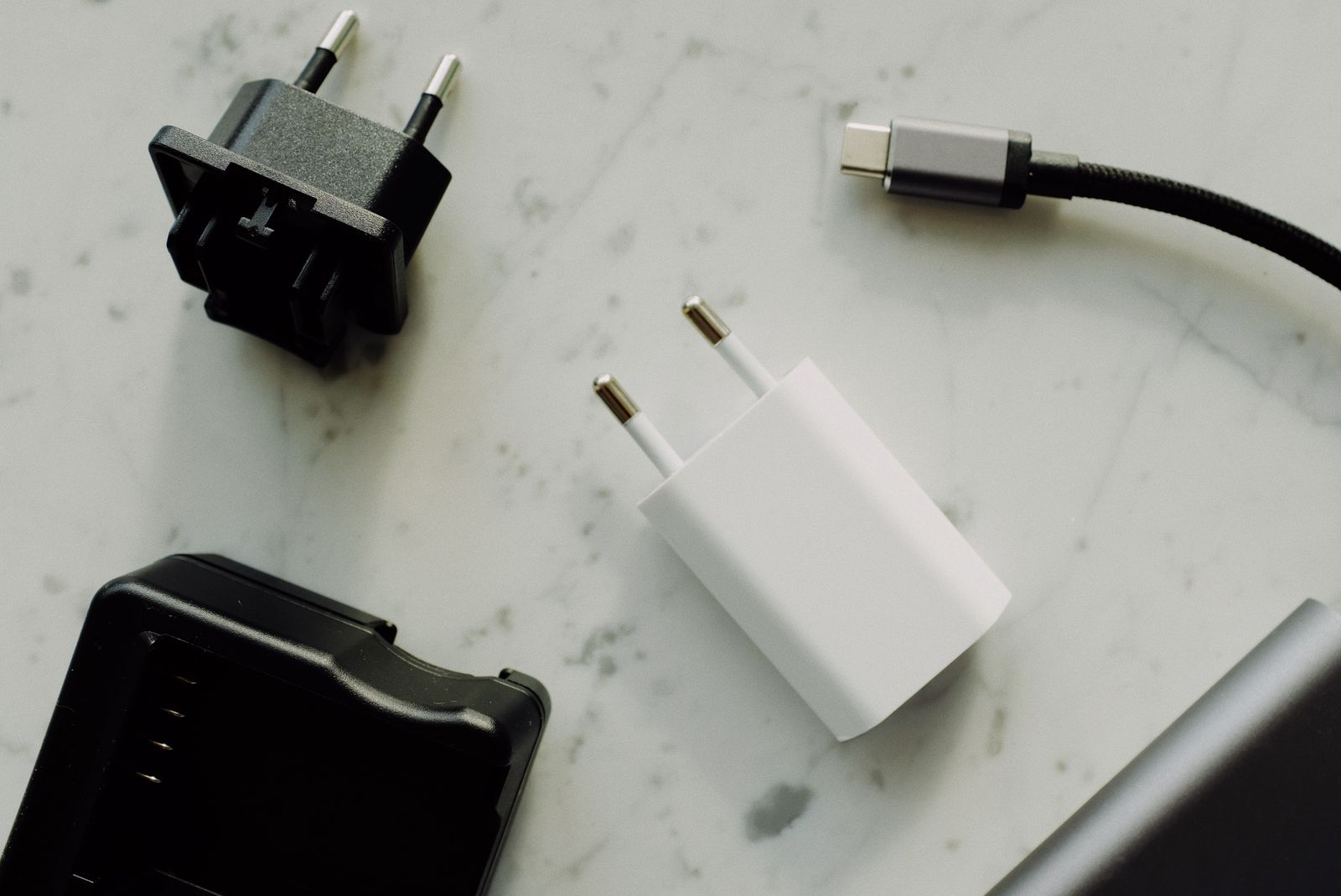
Check the destination's outlet type and choose an adapter intended for it. Verify the adapter's ratings and whether it preserves grounding when the connected equipment requires it. A plug fitting into a multi-country adapter does not prove that every part of the connection is appropriate.
A bulky charger can put strain on a small adapter or sit poorly in a recessed outlet. Consider the physical arrangement as well as the pin pattern. Avoid stacking several adapters to make an awkward combination fit.
If a device needs voltage conversion, a simple plug adapter is insufficient. Get guidance from the device manufacturer on a suitable solution. For ordinary laptop and phone travel, a compatible wide-input charger is often simpler than adding a separate converter, but its exact specifications still need checking.
Pack a tested charging arrangement
Test the charger, cable, and devices together before the trip using a suitable local outlet. Confirm that the cable supports the charging function you need. Keep the destination adapter with that set so it is not left in a different bag.
Read any travel restrictions relevant to batteries or power banks separately. The wall-plug adapter does not answer questions about what may be carried on a flight. Use the carrier's and relevant transport authority's current guidance for those items.
At the destination, use an undamaged outlet and keep the charger uncovered according to its instructions. If a plug is loose, an adapter is damaged, or the setup behaves abnormally, stop using it. Convenience is not a reason to continue with an uncertain electrical connection.